
Latest Vhannibal Settings E2
24/01/2018


Latest Vhannibal Settings E2
24/01/2018
Latest Vhannibal Settings E2
17/01/2018
Did anybody figure this out ?
Latest Vhannibal Settings E2
10/01/2018
I have exactly the same thing happening on 1.1
(Reproduced from Torrent Freak with permission)
A 34-year-old man from the UK has agreed to pay Sky £5,000 after the broadcaster tracked an illegal Facebook stream of the 2017 Joshua v Klitschko fight to his account. Craig Foster, who was warned of a potential £85,000 award should the case go to court, claimed that he wasn't responsible. Backtracking, he says he now wants a fight with Sky.

When people download content online using BitTorrent, they also distribute that content to others. This unlawful distribution attracts negative attention from rightsholders, who have sued hundreds of thousands of individuals worldwide.
Streaming is considered a much safer method to obtain content, since it’s difficult for content owners to track downloaders. However, the same can’t be said about those who stream content to the web for the benefit of others, as an interesting case in the UK has just revealed.
It involves 34-year-old Craig Foster who received several scary letters from lawyers representing broadcaster Sky. The company alleged that during last April’s bout between Anthony Joshua’s and Wladimir Klitschko, Foster live-streamed the multiple world title fight on Facebook Live.
Financially, this was a major problem for Sky, law firm Foot Anstey LLP told Foster. According to their calculations, at least 4,250 people watched the stream without paying Sky Box Office the going rate of £19.95 each. Tapped into Sky’s computers, the broadcaster concluded that Foster owed the company £85,000.
But according to The Mirror, father-of-one Foster wasn’t actually to blame.
“I’d paid for the boxing, it wasn’t like I was making any money. My iPad was signed in to my Facebook account and my friend just started streaming the fight. I didn’t think anything of it, then a few days later they cut my subscription,” Foster said.
“They’re demanding the names and addresses of all my mates who were round that night but I’m not going to give them up. I said I’d take the rap.”
While Foster says he won’t turn in the culprit, there’s no doubt that the fight stream originated from his Sky account. The TV giant embeds watermarks in its broadcasts which enables it to see who paid for an event, should a copy of one turn up on the Internet.
As we reported last year following the Mayweather v McGregor super-fight, the codes are clearly visible with the naked eye.
Sky watermarks, as seen in the Mayweather v McGregor fight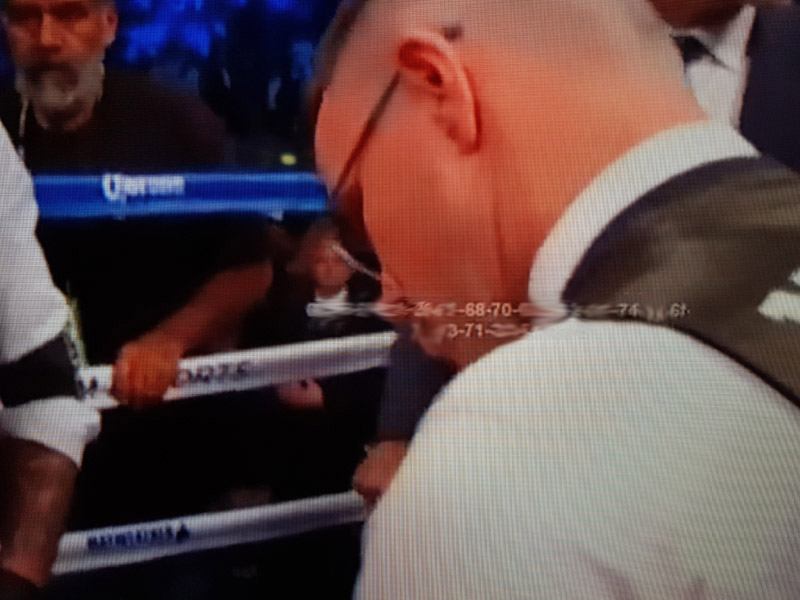
While taking the rap for someone else’s infringing behavior isn’t something anyone should do lightly, it appears that Scarborough-based Foster did just that.
According to Neil Parkes, who specializes in media litigation, content protection and contentious IP at Foot Anstey, Foster accepted responsibility and agreed to pay a settlement.
“Mr Foster broke the law,” Parkes said. “He has acknowledged his wrongdoing, apologised and signed a legally binding agreement to pay a sum of £5,000 to Sky.”
The Mirror, however, has Foster backtracking. He says he wasn’t given enough time to consider his position and now wants to fight Sky in court.
“It’s heavy-handed. I’ve apologized and told them we were drunk,” Foster said.
“I know streaming the fight was wrong. I didn’t stop my friend but I was watching the boxing. I’m just a bloke who had a few drinks with his friends.”
Unless he can find a law firm willing to fight his corner at a hugely cut-down rate, Foster will find this kind of legal fisticuffs to be a massively expensive proposition, one in which he will start out as the clear underdog.
Not only was Foster’s Sky account the originating source, both his iPad and his Facebook account were used to stream the fight. On top of what appears to be a signed confession, he also promised not to do anything else like this in future. Furthermore, he even agreed to issue an apology that Sky can use in future anti-piracy messages.
Of course, Foster might indeed be a noble gentleman but he should be aware that as a civil matter, this fight would be decided on the balance of probabilities, not beyond reasonable doubt. If the judge decides 51% in Sky’s favor, he suffers a knockout along with a huge financial headache.
No one wants a £5,000 bill but that’s a drop in the ocean compared to the cost implications of losing this case.
Latest Vhannibal Settings E2
03/01/2018
Latest Vhannibal Settings E1
03/01/2018
Latest Vhannibal Settings E2
20/12/2017
Sky and BT have have signed a deal to sell their channels on each other's platforms.
Under the deal, BT will now supply its sports channels - which show UEFA Champions League and Premier League football - to Sky.
In addition, BT will be able to sell Sky's Now TV service - which includes Sky Sports, Sky Cinema and the Sky Atlantic channel - to its customers.
The deal comes as the firms face growing competition from online rivals.
Marc Allera, the chief executive of BT consumer, told the BBC that the deal was partly so the firms could join forces against the potential online threat.
"A lot of technology companies are coming into the market with vast budgets, and changing the market. We need to ensure our customers get the best choice," he said.
He said the deal was a "clear indication" of the importance BT attached to how digital and TV markets were converging, adding the firm would bid fiercely for exclusive content.
Bidding is due to begin in the next Premier League football rights auction in February, and digital giants such as Amazon and Facebook could throw their hats in the ring for streaming rights.
However, Mr Allera said: "I wouldn't say [the deal with Sky] takes the pressure off at all... we believe in holding exclusive rights."
BT has spent more than £3.5bn on Champions League and Premier League football rights since 2012 in an attempt to compete with Sky.
Announcing the deal, BT chief executive Gavin Patterson said: "This is the next logical step for our TV and content strategy. We feel that now is the right time to broaden the ways in which we distribute BT Sport."
Sky boss Jeremy Darroch said: "This is great news for Sky customers who will be able to access all matches on Sky and BT channels from the Premier League, UEFA Champions League and Europa League directly with a single Sky TV subscription."
The new services will be available to BT and Sky customers from early 2019.
Richard Broughton, research director at media analysts Ampere, called the deal "very unusual" but said it was a consequence of the rising costs of sports rights.
"The new rights are up for renewal very soon and this is a pre-emptive shot from both companies to limit their exposure to damage should they not get key rights and also allow them to be a little less aggressive in their bidding."
Michael Hewson, an analyst with CMC Markets, said the BT-Sky deal seemed better for BT than Sky, "given that Sky will take BT's sport content while BT gets Sky's sports, cinema and Sky Atlantic channel, and could even gain more access to content further down the road".
He added: "Next February the bidding starts on the latest Premier and Champions League rights and these are not insubstantial amounts of money which might suggest a more collaborative approach between BT and Sky at a time when brands like Amazon and Netflix might look to drive the price of this type of premium content higher."
The big online firms have been part of a seismic shift in how people access content.
On Thursday, Disney announced a deal to buy a large chunk of 21st Century Fox, including its 39% stake in Sky.
Media mogul Rupert Murdoch told Sky News he was selling Fox's entertainment assets in part due to the rise of online giants.
"[Amazon and Netflix] are growth companies... Amazon, I don't know how much they want to do. They are spending $5bn or $6bn I believe on new programmes, but it's basically to widen the appeal of [Amazon] Prime.
"Anyone who joins Prime seems to spend about $3,000 immediately on retail... you know, they are a huge disruptor if you look at what they're doing."
He said the new Fox company that remained would have the strength to bid for sports rights, but that all companies could be "threatened by big nonsensical bids from the likes of Facebook".
Latest Vhannibal Settings E2
13/12/2017
Latest Vhannibal Settings E2
10/12/2017
:welcome4:
Latest Vhannibal Settings E1
05/12/2017
Latest Vhannibal Settings E2
05/12/2017
Latest Vhannibal Settings E2
29/11/2017
Latest Vhannibal Settings E2
22/11/2017
Latest Vhannibal Settings E2
15/11/2017
Latest Vhannibal Settings E2
08/11/2017
(I am sure that many here will disagree with these statements from Sky.... On a side note I have full permisson from TF to use their articles)
Sky's head of litigation made a rather surprising statement at an industry convention in Macau this week. Matthew Hibbert told those in attendance that thanks to site-blocking, it's no longer possible to watch pirated live soccer in the UK anymore. Meanwhile, the UK Intellectual Property Office has revealed that when questioned a while back, rightsholders told them that pirate boxes weren't a problem. How things change.
The commotion over the set-top box streaming phenomenon is showing no signs of dying down and if day one at the Cable and Satellite Broadcasting Association of Asia (CASBAA) Conference 2017 was anything to go by, things are only heating up.
Held at Studio City in Macau, the conference has a strong anti-piracy element and was opened by Joe Welch, CASBAA Board Chairman and SVP Public Affairs Asia, 21st Century Fox. He began Tuesday by noting the important recent launch of a brand new anti-piracy initiative.
“CASBAA recently launched the Coalition Against Piracy, funded by 18 of the region’s content players and distribution partners,” he said.
TF reported on the formation of the coalition mid-October. It includes heavyweights such as Disney, Fox, HBO, NBCUniversal and BBC Worldwide, and will have a strong focus on the illicit set-top box market.
Illegal streaming devices (or ISDs, as the industry calls them), were directly addressed in a segment yesterday afternoon titled Face To Face. Led by Dr. Ros Lynch, Director of Copyright & IP Enforcement at the UK Intellectual Property Office, the session detailed the “onslaught of online piracy” and the rise of ISDs that is apparently “shaking the market”.
Given the apparent gravity of those statements, the following will probably come as a surprise. According to Lynch, the UK IPO sought the opinion of UK-based rightsholders about the pirate box phenomenon a while back after being informed of their popularity in the East. The response was that pirate boxes weren’t an issue. It didn’t take long, however, for things to blow up.
“The UKIPO provides intelligence and evidence to industry and the Police Intellectual Property Crime Unit (PIPCU) in London who then take enforcement actions,” Lynch explained.
“We first heard about the issues with ISDs from [broadcaster] TVB in Hong Kong and we then consulted the UK rights holders who responded that it wasn’t a problem. Two years later the issue just exploded.”
The evidence of that in the UK isn’t difficult to find. In addition to millions of devices with both free Kodi addon and subscription-based systems deployed, the app market has bloomed too, offering free or near to free content to all.
This caught the eye of the Premier League who this year obtained two pioneering injunctions (1,2) to tackle live streams of football games. Streams are blocked by local ISPs in real-time, making illicit online viewing a more painful experience than it ever has been. No doubt progress has been made on this front, with thousands of streams blocked, but according to broadcaster Sky, the results are unprecedented.
“Site-blocking has moved the goalposts significantly,” said Matthew Hibbert, head of litigation at Sky UK.
“In the UK you cannot watch pirated live Premier League content anymore,” he said.
While progress has been good, the statement is overly enthusiastic. TF sources have been monitoring the availability of pirate streams on around dozen illicit sites and services every Saturday (when it is actually illegal to broadcast matches in the UK) and service has been steady on around half of them and intermittent at worst on the rest.
There are hundreds of other platforms available so while many are definitely affected by Premier League blocking, it’s safe to assume that live football piracy hasn’t been wiped out. Nevertheless, it would be wrong to suggest that no progress has been made, in this and other related areas.
Kevin Plumb, Director of Legal Services at The Premier League, said that pubs showing football from illegal streams had also massively dwindled in numbers.
“In the past 18 months the illegal broadcasting of live Premier League matches in pubs in the UK has been decimated,” he said.
This result is almost certainly down to prosecutions taken in tandem with the Federation Against Copyright Theft (FACT), that have seen several landlords landed with large fines. Indeed, both sides of the market have been tackled, with both licensed premises and IPTV device sellers being targeted.
“The most successful thing we’ve done to combat piracy has been to undertake criminal prosecutions against ISD piracy,” said FACT chief Kieron Sharp yesterday. “Everyone is pleading guilty to these offenses.”
Most if not all of FACT-led prosecutions target device and subscription sellers under fraud legislation but that could change in the future, Lynch of the Intellectual Property Office said.
“While the UK works to update its legislation, we can’t wait for the new legislation to take enforcement actions and we rely heavily on ‘conspiracy to defraud’ charges, and have successfully prosecuted a number of ISD retailers,” she said.
Finally, information provided yesterday by network company CISCO shine light on what it costs to run a subscription-based pirate IPTV operation.
Director of Intelligence & Security Operations Avigail Gutman said a pirate IPTV server offering 1,000 channels to around 1,000 subscribers can cost as little as 2,000 euros per month to run but can generate 12,000 euros in revenue during the same period.
“In April of 2017, ten major paid TV and content providers had relinquished 3.09 million euros per month to 285 ISD-based streaming pirate syndicates,” she said.
There’s little doubt that IPTV piracy, both paid and free, is here to stay. The big question is how it will be tackled short and long-term and whether any changes in legislation will have any unintended knock-on effects.

