


:welcome4:
Posts by Prophet
-
-
Latest Vhannibal Settings E2
13/09/2017
-
Latest Vhannibal Setting E1
06/09/2017
-
Latest Vhannibal Settings E2
06/09/2017
-
Latest Vhannibal Setting E2
30/08/2017
-
:welcome4:
-
Freesport confirms Freesat channel details

FreeSports, the new free-to-air sports channel launching soon, has confirmed further details about its service.
The channel, being launched by the people behind Premier Sports and the former Setanta UK service, has confirmed it will appear to viewers on Freesat channel 252, in addition to the previously announced slots on Sky 424 and Freeview / YouView (BT/TalkTalk) channel 95. The channel expects to reach 22 million homes from September.
Further information on sports types to be screened on the channel have also been provided: FreeSports will feature Football, Rugby League, Tennis, Ice Hockey, MMA, Basketball, Cricket, Speedway, Nascar, Athletics and Wrestling, essentially beccoming a free-to-air version of Premier Sports, which already provides coverage of these sports on a pay TV basis.
Freesports will thus become the first comprehensive multi-discipline sports channel on Freesat; the free-to-air satellite service already has cycling channel BIKE and Greyhound Racing / Casino channel Front Runner 2 on channels 250 and 251.Source: http://www.a516digital.com/201…irms-freesat-details.html
-
Latest Vhannibal Setting E2
16/08/2017
-
This weekend the Premier League began a new round of actions targeting illegal streaming. Reports reveal disruption at many IPTV providers, with some indicating that using VPNs is now a must for UK IPTV subscribers. Interestingly, however, sources at some providers claim to have already mitigated the threat.

Top tier football in the UK is handled by the English Premier League (EPL) and broadcasting partners Sky and BT Sport. All face considerable problems with Internet piracy, through free web or Kodi-based streaming and premium IPTV feeds.
To mitigate the threat, earlier this year the Premier League obtained a unique High Court injunctionwhich required ISPs such as Sky, BT, and Virgin to block ‘pirate’ football streams in real-time.
Although the success of the program was initially up for debate, the EPL reported it was able to block 5,000 server IP addresses that were streaming its content. When that temporary injunction ran out, the EPL went back to court for a new one, valid for the season that began this past weekend. There are signs the EPL may have upped its game.
As soon as the matches began on Saturday, issues were reported at several of the more prominent IPTV providers. Within minutes of the match streams going live, subscribers to affected services were met with black screens, causing anger and frustration. While some clearly knew that action was on the cards, relatively few had an effective plan in place.
One provider, which targets subscribers in the UK, scrambled to obtain new domain names, thinking that the existing domains had been placed on some kind of Premier League blacklist. While that may have indeed been the case, making a service more obscure in that sense was never going to outwit the systems deployed by the anti-piracy outfits involved.
Indeed, the provider in question was subjected to much chaos over both Saturday and Sunday, since it’s clear that large numbers of subscribers had absolutely no idea what was going on. Even if they understood that the EPL was blocking, the change of domain flat-footed the rest. The subsequent customer service chaos was not a pretty sight but would’ve been a pleasure for the EPL to behold.
An interesting side effect of this EPL action is that even if IPTV subscribers don’t care about football, many were affected this past weekend anyway.
TF is aware of at least three services (there are probably many more) that couldn’t service their UK customers with any other channels whatsoever while the Premier League games were being aired. This suggests that the IP addresses hit by the EPL and blocked by local ISPs belonged to the same servers carrying the rest of the content offered by the IPTV providers.
When the High Court handed down its original injunction it accepted that some non-Premier League content could be blocked at the same time but since that “consists almost exclusively of [infringing] commercial broadcast content such as other sports, films, and television programs,” there was little concern over collateral damage.
So the big question now is what can IPTV providers and/or subscribers do to tackle the threat?
The first interesting thing to note is not all of the big providers were affected this past weekend, so for many customers the matches passed by as normal. It isn’t clear whether EPL simply didn’t have all of the providers on the list or whether steps were taken to mitigate the threat, but that was certainly the case in a handful of cases.
Information passed to TF shows that at least a small number of providers were not only waiting for the EPL action but actually had a backup plan in place. This appears to have resulted in a minimum of disruption for their customers, something that will prove of interest to the many frustrated subscribers looking for a new service this morning.
While the past few days have been somewhat chaotic, other issues have been muddying the waters somewhat.
TF has learned that at least two, maybe three suppliers, were subjected to DDoS attacks around the time the matches were due to air. It seems unlikely that the EPL has been given permission to carry out such an attack but since the High Court injunction is secret in every way that describes its anti-piracy methods, that will remain a suspicion. In the meantime, rival IPTV services remain possible suspects.
Also, a major IPTV stream ‘wholesaler’ is reported to have had technical issues on Saturday, which affected its ability to serve lower-tier providers. Whether that was also linked to the Premier League action is unknown and TF couldn’t find any source willing to talk about the provider in any detail.
So, sports fans who rely on IPTV for their fix are wondering how things will pan out later this week. If this last weekend is anything to go by, disruption is guaranteed, but it will be less of a surprise given the problems of the last few days. While some don’t foresee huge problems, several providers are already advising customers that VPNs will be necessary.
An IPTV provider suggesting the use of VPNs
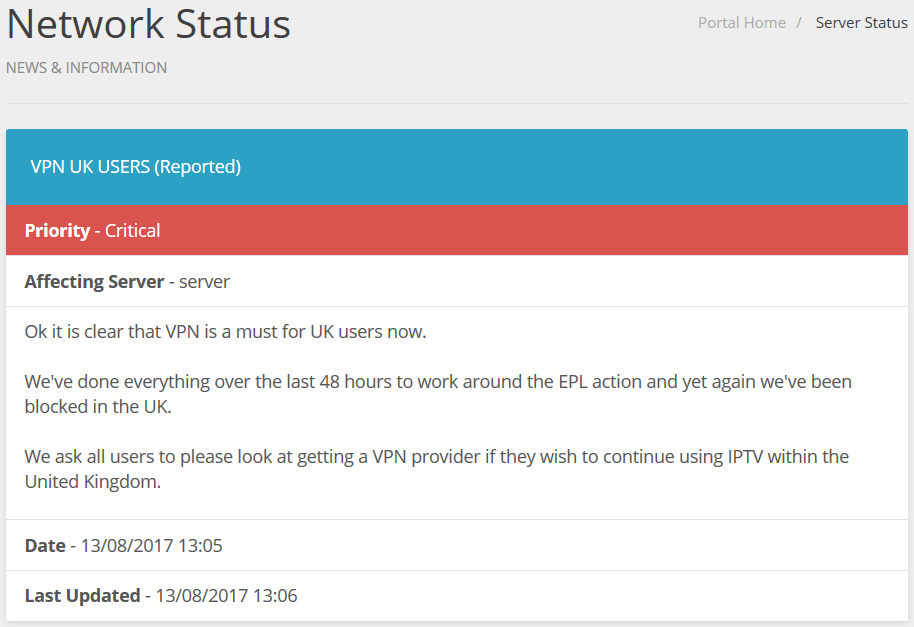
While a VPN will indeed solve the problem in most cases, for many subscribers that will amount to an additional expense, not to mention more time spent learning about VPNs, what they can do, and how they can be setup on the hardware they’re using for IPTV.
For users on Android devices running IPTV apps or Kodi-type setups, VPNs are both easy to install and use. However, Mag Box STB users cannot run a VPN directly on the device, meaning that they’ll need either a home router that can run a VPN or a smaller ‘travel’ type router with OpenVPN capabilities to use as a go-between.
Either way, costs are beginning to creep up, if IPTV providers can’t deal with the EPL’s blocking efforts. That makes the new cheaper football packages offered by various providers that little bit more attractive. But that was probably the plan all along.
Source: https://torrentfreak.com/new-p…te-iptv-providers-170814/
-
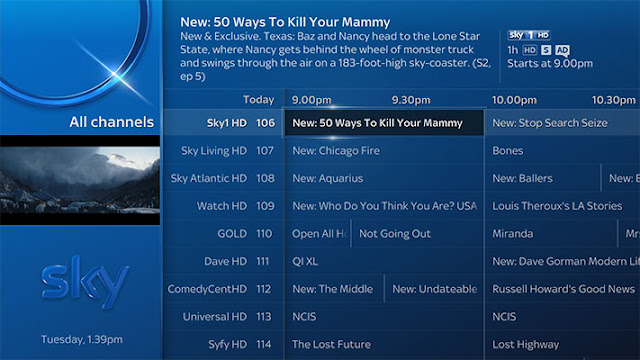
Sky is planning to tackle the jumble of channels on its service.
The satellite TV provider's electronic programme guide is due to be revamped in 2018, following a consultation exercise with broadcasters and other stakeholders.
Currently, Sky subscribers have to navigate through a jumble of HD/SD simulcasts and +1s to find channels, with no discernible order applied to some parts of the guide following years of moves, launches, takeovers and closures of channels.
According to the consultation document on the method for allocating listings on the Sky EPG, Sky wants to merge entertainment and documentaries into one genre, following a similar move that brought lifestyle channels into the entertainment genre three years ago. The current proposal would see the likes of National Geographic, Discovery, Blaze and PBS America move up the EPG and appear among entertainment channels.
+1 channels would be grouped up and moved to their own section.
Children's channels would move to a channel range starting at 250. However, the order of children's channels on Sky has been a bone of contention with the BBC, who argue that CBBC and CBeebies should be listed first as public service broadcasting channels.
HD simulcasts of the main 5 channels would be forced to the top slots, providing the correct regional version is available in HD. ITV, for example, broadcasts multiple regional versions of ITV HD, but doesn't offer the channel on Sky channel 103 in England, even in regions where the HD version is identical to the SD version. It would be forced to do so under the plans, with the SD version moving near the bottom of the EPG. In regions where there isn't a like-for-like version, the SD version would remain on 103. Channel 4 would face a similar move affecting the London version of its main service, which mirrors the HD channel.
Providing there aren't any major objections, the new channel listing would come into force on 1st March 2018.Source : http://www.a516digital.com/201…up-for-big-reshuffle.html
-
Hotspot Shield VPN, a popular service that claims to enhance users' privacy while providing anonymity, has been reported to the Federal Trade Commission. The Center for Democracy & Technology has called for an investigation, claiming that the service logs user activity and employs third-party tracking mechanisms to deliver targeted advertising.

With online privacy becoming an increasingly hot topic, large numbers of companies are offering products which claim to stop third-parties from snooping on users’ Internet activities.
At the forefront are Virtual Private Networks (VPN), which push consumer traffic through encrypted tunnels and remote servers to hide activity from ISPs while offering varying levels of anonymity.
Claims made by VPN companies are often scrutinized by privacy advocates but if a complaint filed this morning by the Center for Democracy and Technology
(CDT) gains momentum, there could be a government investigation into one of the most popular.Developed by AnchorFree, Inc. and initially released more than nine years ago, the Hotspot Shield application allows users to connect to a VPN service. According to its makers, it’s been downloaded 75 million times and provides “anonymous web surfing with complete privacy.” That claim, however, is now under the spotlight.
In a complaint filed this morning with the Federal Trade Commission, CDT notes that Hotspot Shield makes “strong claims” about the privacy and security of its data collection and sharing practices, including that it “never logs or stores user data.” Crucially, the company also claims never to track or sell its customers’ information, adding that security and privacy are “guaranteed.”
Countering, CDT says that Hotspot Shield engages in logging practices that contradict its claims, noting that it collects information to “identify [a user’s] general location, improve the Service, or optimize advertisements displayed through the Service.”
The complaint says that IP addresses and unique device identifiers are regularly
collected by Hotspot Shield but the service gets around this issue by classing neither sets of data as personal information.CDT says it used Carnegie Mellon University’s Mobile App Compliance System to gain insight into Hotspot Shield’s functionality and found problems with privacy.
“CMU’s analysis of Hotspot Shield’s Android application permissions found undisclosed data sharing practices with third party advertising networks,” the group notes.
“While an ad-supported VPN may be beneficial in certain instances, it should not be paired with a product or service that tells users that it ensures anonymity, privacy, and security.”
CDT also says that Hotspot Shield tries to cover its back with a disclaimer that the company “may not provide a virtual IP Address for every web site you may visit and third-party web sites may receive your original IP Address when you are visiting those web sites.” But this runs counter to the stated aim of the service, CDT writes.
Accusing Hotspot Shield of unfair and deceptive trade practices, CDT calls on the Commission to conduct an investigation into its data collection and sharing practices.
Hotspot Shield is yet to respond to the complaint or accusations but in a 2014 blog post, welcomed the FTC’s involvement in online security issues.
Full complaint here, courtesy Ars
Source: https://torrentfreak.com/hotsp…06.1893820762634277343750
-
A man who sold so-called "fully loaded Kodi boxes" over a 30 month period has pleaded guilty to money laundering offenses. Julian Allen was arrested by police in 2015 following a joint operation with Trading Standards officers and Sky TV. Authorities will now try to recover more than £135,000.

In June 2015, police and Trading Standards officers in the UK carried out raids on sellers of Android boxes configured to receive unauthorized content. One seller, operating from GeekyKit.com, told customers that his physical shops would be shutting down.
“As you may be aware we were visited yesterday by Sky [television] in conjunction with Trading Standards. Whilst we continue to investigate our position the stores will remain closed and support will remain suspended. Our sincere apologies for any inconvenience caused,” he explained.
Julian Allen was arrested after raids at ‘Geeky Kit’ premises in Billingham and Middlesbrough in the north of England. One of the locations is pictured below.
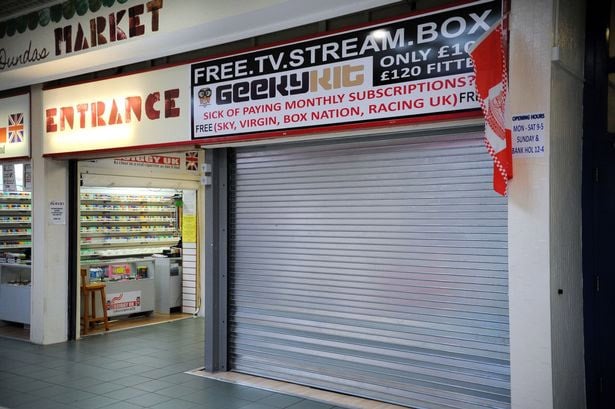
Despite the seriously incriminating storefront claims, Allen insisted that his businesses couldn’t be held responsible for copyrighted TV shows, movies and sports received by customers on boxes his company supplied.
“We do not control the content that is accessible on the internet via the product that we sell. We are currently working with Trading Standards to ensure that we can sell our products whilst adhering to UK copyright laws,” he said.
This January, Allen appeared before Teesside Crown Court charged with laundering £135,173, money said to have been generated via the sale of pre-loaded set-top boxes and premium packages over a 30-month period.
Allen was expected to appear for a week-long trial scheduled to start this Monday but that was scrapped after the 40-year-old pleaded guilty to using or acquiring criminal property.
According to Gazette Live, a proceeds of crime hearing has been scheduled for next year. In the meantime, Allen was granted unconditional bail until sentencing on October 20, where he faces a potential jail sentence.
“I don’t know what the sentence will be until all the matters are known,” the judge said.
Ever since a European Court of Justice ruling earlier this year that found that selling “fully-loaded” streaming boxes are illegal, people in a similar position to Allen have seen their cases take a turn for the worse.
One such case, involving Middlesbrough shopkeeper Brian Thompson, appears to be progressing under different legislation, however. Thompson stands accused of two offenses under section 296ZB of the Copyright, Designs and Patents Act, which deals with devices and services designed to circumvent technological measures.
Source: https://torrentfreak.com/selle…-money-laundering-170806/
-
Latest Vhannibal Setting E1
03/08/2017
-
Latest Vhannibal Setting E2
02/08/2017
-
all doomed, get them 1m dishes out lol
haha, I just sold my 1.25 Gib last weekend as well
-
Latest Vhannibal Setting E2
27/07/2017
-
The UK's Premier League has obtained a new High Court injunction that will enable it to continue the fight against illicit online soccer streaming next season. In common with an order obtained earlier this year, the new injunction will require ISPs to promptly block access to Internet servers illegally distributing Premier League content.
Earlier this year the Premier League obtained a rather special High Court injunction to assist in its fight against illegal football match streaming.
Similar in its aims to earlier blocking orders that targeted torrent sites including The Pirate Bay, the injunction enabled the Premier League to act quickly, forcing local ISPs such as Sky, BT, and Virgin to block football streams in real-time.
Although public results varied, the English Premier League (EPL) reports that under the injunction it was able to block 5,000 server IP addresses that were streaming its content. That appears to have encouraged the organization to apply for another injunction for the upcoming 2017-18 season.
According to a statement published on the EPL site, that has now been granted.
“This blocking order is a game-changer in our efforts to tackle the supply and use of illicit streams of our content,” said Premier League Director of Legal Services, Kevin Plumb.
“It will allow us to quickly and effectively block and disrupt the illegal broadcast of Premier League football via any means, including so called ‘pre-loaded Kodi boxes’.”
Although the details of the new injunction are yet to be published by the High Court, the EPL indicates that the injunction is very similar to the one obtained previously, which targets overseas servers streaming Premier League matches into the UK.
Upon notice from the Premier League, ISPs including Sky, BT, Virgin Media, Plusnet, EE and TalkTalk are required to block IP addresses quickly as matches are being streamed, all without any direct intervention from the court.
“The protection of our copyright, and the investment made by our broadcast partners, is hugely important to the Premier League and the future health of English football,” the Premier League said.
The injunction itself lists the Internet service providers as defendants but it’s important to note that most have a vested interest in the injunction being put in place. Sky, BT and Virgin Media all screen Premier League matches in some way so there’s no surprise that none put up a fight when confronted by the football organization.
Indeed, several of the ISPs appeared to have assisted the EPL in some pretty intimate ways, even going as far as sharing a certain level of customer traffic data with the organization.
It will be interesting to see what effect the new blocking efforts will have on stream availability when the new season begins. Saturday afternoons, when matches take place around the country but are prohibited from being screened due to the blackout, should be the main focal point. As previously suggested, the EPL will probably enjoy more success than last season with experience under their belts.
Finally, tabloids in the UK have been giving the injunction their usual dramatic coverage but a special mention must go out to The Sun. In an article titled “Closing the Net“, the paper said that under the injunction, “BRITS who illegally stream Premier League football matches could have their internet connection shut off.”
The way things are worded it suggests that people who watch streams could be disconnected by their ISP. That is not the case.
Source https://torrentfreak.com/premi…n-to-fight-piracy-170727/
-

The management team behind Setanta Sports and Premier Sport are preparing to launch a new sports channel in the UK.
FreeSports, which this week received Ofcom licences covering satellite, cable and terrestrial platforms, promises to offer a variety of sports on a free-to-air basis from September 2017.
The channel's directors include Richard Sweeney and Michael O'Rourke from Setanta Sports and Premier Sports. Setanta Sports Broadcasting Limited of Dublin is listed as third director, according to Companies House, under rules that allow companies to be directors.
Details of the types of sport the channel will offer viewers and a precise launch date haven't yet been disclosed.
The management team are once again working with broadcast infrastructure company Arqiva to get the channel on to viewer's screens, having worked together since the days of Setanta Sports UK.
Arqiva has provided Freeview capacity on its COM8 multiplex, with the new channel's signal due to reach up to 3/4 of UK households via devices that support Freeview HD or Freeview Play. A placeholder for the new service now appears on Freeview 95 for viewers in the coverage area. Details about carriage on other platforms are still to be confirmed.
FreeSports will be the third sports channel to launch on Freeview since 2014. Attempts to establish a permanent sports channel on Freeview have thus far failed, with Motors TV (now known as Motorsport.tv) and Front Runner both withdrawing from Freeview after a few months on air.
Setanta first announced it was planning a Freeview sports channel in 2003. From 2006, Setanta Sports operated a pay TV channel on UK digital terrestrial TV through the now defunct Top Up TV service, piggybacking on the signal carrying Freeview channels to households. Since Setanta Sports collapsed off air in the UK in 2009, the business has continued elsewhere, operated through a web of different limited companies registered in various countries, but backed by the same management team. Setanta Sports Ireland was taken over by eir Telecom at the end of 2015 and rebranded to eir Sports in 2016. Parts of the Setanta empire have continued in the UK under the Premier Sports brand since 2010.
During 2003 and 2004 there had been plans to launch a sports channel on Freeview under the Freesports brand. That channel was originally due to specialise in coverage of minority sports.Source: http://www.a516digital.com/201…ts-channel-to-launch.html
-
I am closing this one too, seeing as the other thread is now closed and the question addressed
-
I am going to go ahead and close this thread now for a few reasons
a. The o.p. has stated the project has finished
b. The o.p. has stated it would cost each person £2000 per box, not something we do here
c. Things are getting pretty off topic
If one of the Admin team wish to re open the thread so be it, but for now it's closed



