

Using an 18ft “Monster Dish” for Ku-band

There are 10 replies in this Thread which was already clicked 1,227 times. The last Post () by supwiddiss.

  • Has anyone here actually tried using a big C-band prime focus dish for weak Ku-band tracking?


    I’ve got a chance to pick up an 18ft monster dish (old cable operator type, super heavy-duty, industrial-grade, excellent condition) for really cheap, and I’m seriously considering turning it into a Ku DX setup.


    At the same time, in a similar budget (just a bit more), I’m also getting a 12ft Ku-band dish from JAMES company — sharing link below — but that one doesn’t look as heavy-duty or industrial-grade like the big C-band dish.
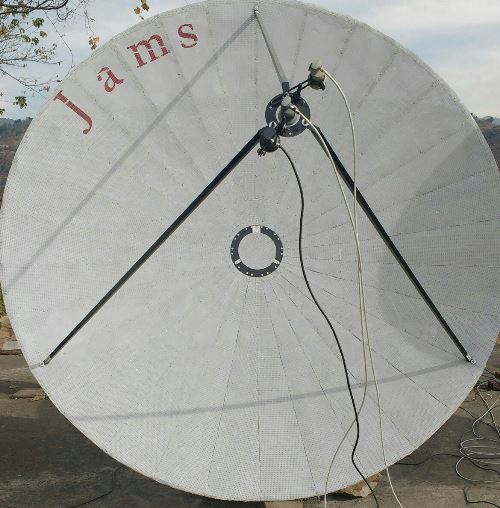

    12ft Ku/Ka band Dish Antenna - Jams India - Manufacturers and Trader of Satellite Dish Antenna, Lnbs, Satellite dish antenna product, Satcom Products ,
    Specification: Antenna Size 3.7 meters/12 ft. Antenna Type Parabolic Feed Type Prime Focus F/D Ratio 0.67 Focal Length 96.48-Inch Double Ribs 12 Total Ribs 36…
    www.jamsindia.com

    Also for reference, similar C-band type dish:
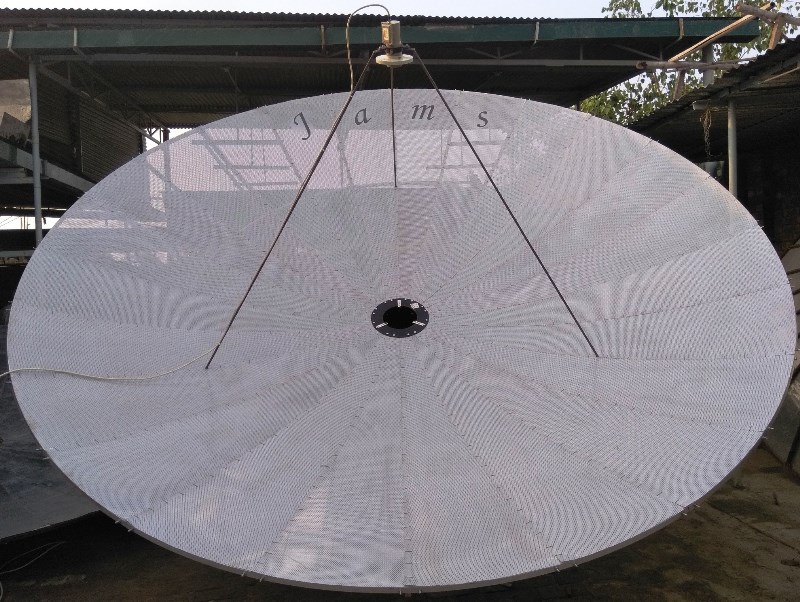
    16 ft. C-Band Dish Antenna - Jams India - Manufacturers and Trader of Satellite Dish Antenna, Lnbs, Satellite dish antenna product, Satcom Products ,
    Customizations are available, suiting every budget and customer requirement.   Specification: Antenna Size 4.87 meters/16 ft. Antenna Type Parabolic Feed Type…
    www.jamsindia.com

    So I’m confused between going for a huge 18ft “backyard monster” dish vs a proper 12ft Ku dish but lighter build.

    Main questions:

    • Has anyone practically used large C-band dishes (12ft / 16ft / 18ft) for Ku-band DX?
    • How does it perform on very weak signals in real life?
    • What would an 18ft C-band dish roughly equal in Ku dish size (10ft? 12ft?)
    • Is the low F/D ratio a big limitation practically, or manageable with feed setup?
    • Which would you pick for weak Ku hunting:
      → 18ft heavy-duty C-band dish
      → or 12ft Ku-band dish (JAMES)

    Looking for real-world experience, especially from DX guys

  • master G

    Approved the thread.
  • A dish is just a reflector with a focal point. It doesnt matter if its C band or KU band, the signal will still be reflected to that focal point and as long as you have a KU band feedhorn and LNB your good to go. It should in theory still perform the same as an 18ft dish with KU band just as it did with C band.


    The only issue you might have with a dish that size is interference from nearby satellites. It might see 13E and 10E as being in the same position, it will deffo see 9E and 10E that way and if frequencies on these sats overlap you may struggle to tune in certain channels if they share the same frequencies.


    Good luck in your venture, you need a lot of space and very understanding neighbours lol

  • A dish is just a reflector with a focal point. It doesnt matter if its C band or KU band, the signal will still be reflected to that focal point and as long as you have a KU band feedhorn and LNB your good to go. It should in theory still perform the same as an 18ft dish with KU band just as it did with C band.


    The only issue you might have with a dish that size is interference from nearby satellites. It might see 13E and 10E as being in the same position, it will deffo see 9E and 10E that way and if frequencies on these sats overlap you may struggle to tune in certain channels if they share the same frequencies.


    Good luck in your venture, you need a lot of space and very understanding neighbours lol

    Really appciate your inputs.However i think big dish have more narrow beam and it will do oppsite. It will seprate even 0.5 deg difference satellites.

    Have you practically tried ku band on c band dish?

  • I am using a Geosat Pro ku band lnbf on my 12' dish here in the usa. A more proper setup would be using a proper Invacom lnbf with scalar.

    And using the Geosat lnbf. Designed for an offset dish for ku band does in fact only utilize around a 1m "circle" of the dish. I proved that by using some aluminum sheets to obscure the signal until I was loss.
    So. A proper prime feed lnbf would be in order to "do it right". Ku band in the USA just has iffy content as compared to c band.

    A dish is just a reflector is a fuzzy statement. I questioned why some of the affordable eBay dishes like used for microwave links stated that they were designed for higher GHz usage. So a bit of reading turned up "beamwidth".
    In school you learned that a paraboloid is a paraboloid. Parabolic has no real variants.
    Jump into microwave communcations and you find out different.
    So a prime focus c band dish working ku band, ka, etc should have vastly different performance.
    And it makes sense. Going back to adjacent satellite interference. Like Ian said.
    Point-to-point microwave dishes can be engineerd to limit beamwidth down to certain limits by varying the parabolic shape.
    But wait. A paraboloid has no exceptions. Right? Nope. not so in the RF world.
    A deep, shallow focal point dish gived different beamwidth.

    Such is the case of my recent 12' dish tweaking to let me track the arc as accurately as can be from 127W out to at least 34W.
    I was at the lower arc scanning ku sats one by one with satellite charts at hand. Move the dish a bit. Blindscan (a spectrum analyzer would have been the hot ticket). And see what came up. Look at the chart and match up the scanned transponders. Not using the lamedb....real blindscan.
    Tweak the position for max signal. Store the position in the dish mover. Blindscan again. Add the tp's not in the charts to the satellites.xml file.
    Makes the next scan go faster. We have wildfeeds that pop up new tp's for games, events, etc. So a sat that is dead during the week can come alive on the weekend with transponders and symbol rates new to them not listed in any satellite chart.

    Okay. I got confused. With the offset dish lnbf on my prime focus dish. I got transponders that made no sense in a scan.
    C band "bleed over" isn't a thing here. The 12' dish doesn't experience the 2 degree spacing interfrence and menu option to ignore adjacent satellites within a specified setting.
    The satellites adjacent to the target were bleeding over. I still havent got it 100% sorted. I need to work on that coamparing charts and signal strength.

    Let me say something about the Indian dish you're interested in. A search result with them "in my face" might look tasty.
    Can they provide full specifications of them? I mean full. Not just "a dish for a great price". It may be that they are made very well. Or, it's a dish and there you have it.

    When c band boomed here in the 80's and everyone was selling them. There were the ones who sold Prodelin. Other commercial dishes designed and built with precision.
    My 12' fiberglass dish was built locally as well as the polar mount. I spoke with the now old guy who built, installed, and serviced them before he passed away a few years ago.
    He bought a few different brands os dishes for installs.
    Mine and the ones like it is a Prodelin copy. From what I gather. The dish itself was placed in a big sand pit with the dish facing the sky like there was a satellite up there.
    Then they sprayed it with a release agent. And poured an aerated plaster mix into it. Let it set. And pulled it all out of the pit and flipped it over.
    I'm guessing as is typical, the stuff they used shrunk a touch.

    Because my use-a-string-and ruler f and f/D and whatever cacls a few years ago in real life showed that the focal point and scalar position was quite a bit different. The actual focal point is closer to the dish center. Shallow focus.

    They then put release agent on the plaster after fabricating a rim. Put a layer of resin and thin fibergalss cloth down.
    Used a metal sprayer like you would see in a machine shop to restore worn shaft bearing surfaces.
    Sprayed the fiberglass with a good layer. And added another few layers of fiberglass mesh and resin.
    When setup and hard. They then pulled the dish from the mold and finished them with gel coat and boat epoxy paint.
    It's heavy. Over the years it has sagged a very small amount. Fixed that with wires and stainless porch rail turmbuckles.

    But. It's a copy. Works well for it's age. It's not the Prodelin that it started out to be. There is not one single specification available except what I've derived of it. I have no idea of it's gain, beamwidth. It works. Still.

    Ask me more is you wish.

  • Here are the specs I have for the dish:

    • Prime focus design
    • F/D ratio: ~0.4
    • Mesh type: wire mesh / punched sheet (painted)
    • Mount: Az/El (360° az, 5–90° el)
    • Material: aluminum reflector reinforced with steel
    • Ribs: 24
    • Pointing accuracy: ±0.2°
    • Gain: ~35.5 dB (C-band)
    • Operating freq: 3.4–4.8 GHz

    It’s basically a heavy-duty cable operator style C-band dish.

  • From what I see. They have stabbed a mess of offset dish ku band lnb's on it. No c band lnbf even in the scalar bore.
    And as I mentioned. The offset dish lnbs will not utilize the entire diameter of the dish. For that you would need a feed like Invacom has with proper scalar.
    You mention that you wish to go hunting. Over the Indian dish I would definitely choose the headend dish over them many times over.
    Same some cash and work on obtaining or building, having built a polar mount.
    Hunting with an ez el would be just a royal PITA. Seriously. I mean. Up/down, Right/left. Where the heck is it?? Nope. Polar mount all the way.
    Even if your're looking for that elusive inclined orbit satellite. And for very weak or on the fringe of the footprint? No other way.
    Save your money.

  • The gain mentioned of 35db seems awful low for a reflector of that size?

    oh my bad

    here is correct detail for 16ft from similar manufacturer as tgat headend dish dont have any online spects
    so 18ft will have bit higher gain i guess.


    Gain at 50% efficiency43.20 dBi

Get help choosing and installing satellite equipment.

Whether you're new or upgrading, post here for community-driven buying guides and setup advice.